Bridge of the Gods Corporation

Stocks, Spans, and Showmen

The Bridge of the Gods Corporation was approved to sell $300,000 worth of stock in Washington in 1921 and $250,000 of stock in Oregon in 1923. Stock sold for $1 per share. R.R. Clark was hired to design and engineer the bridge. L.A. Thomas served as a consulting architect. They favored a suspension bridge, stating that this design would best sustain strong Gorge winds. The Young McDonald Company built the first pier in April of 1922.
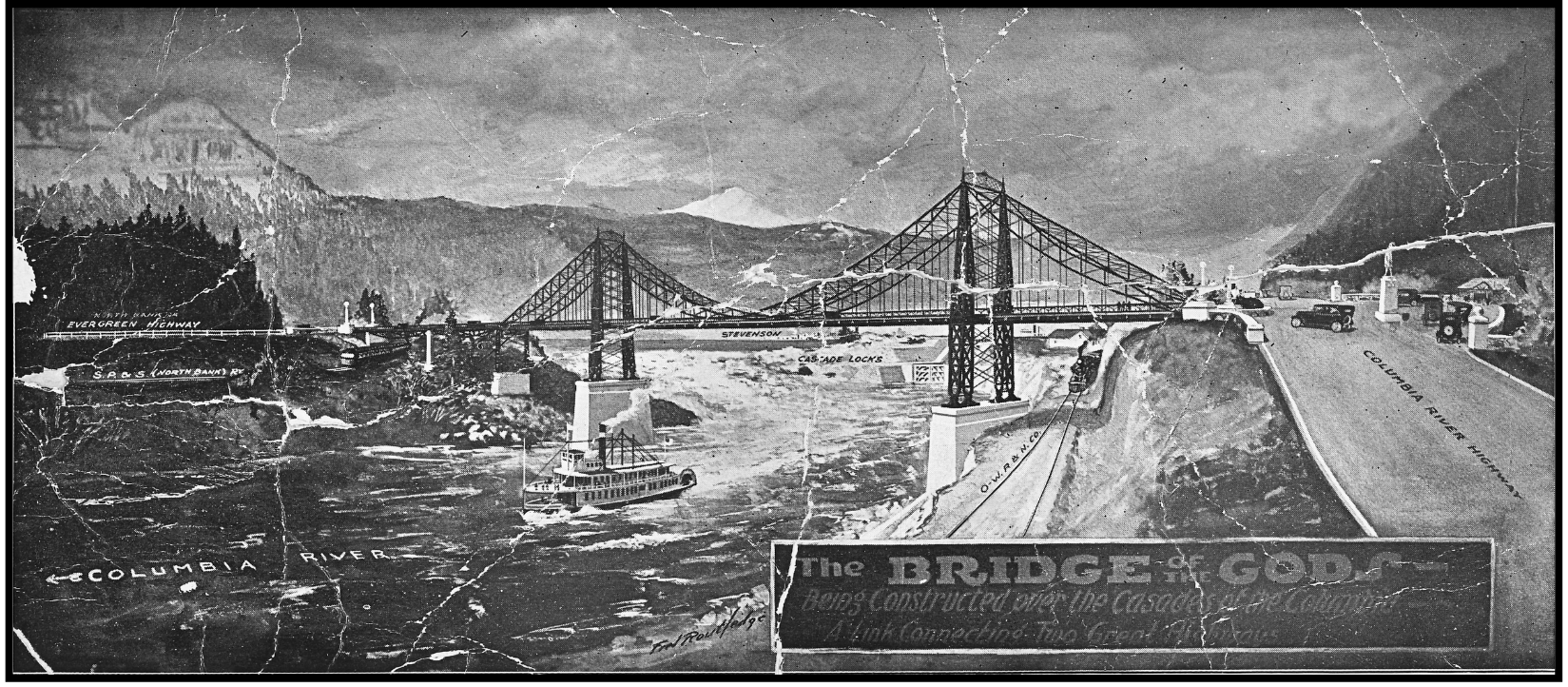
Artistic rendering of the Bridge of the Gods as a suspension bridge with boats on the river and cars on the highway

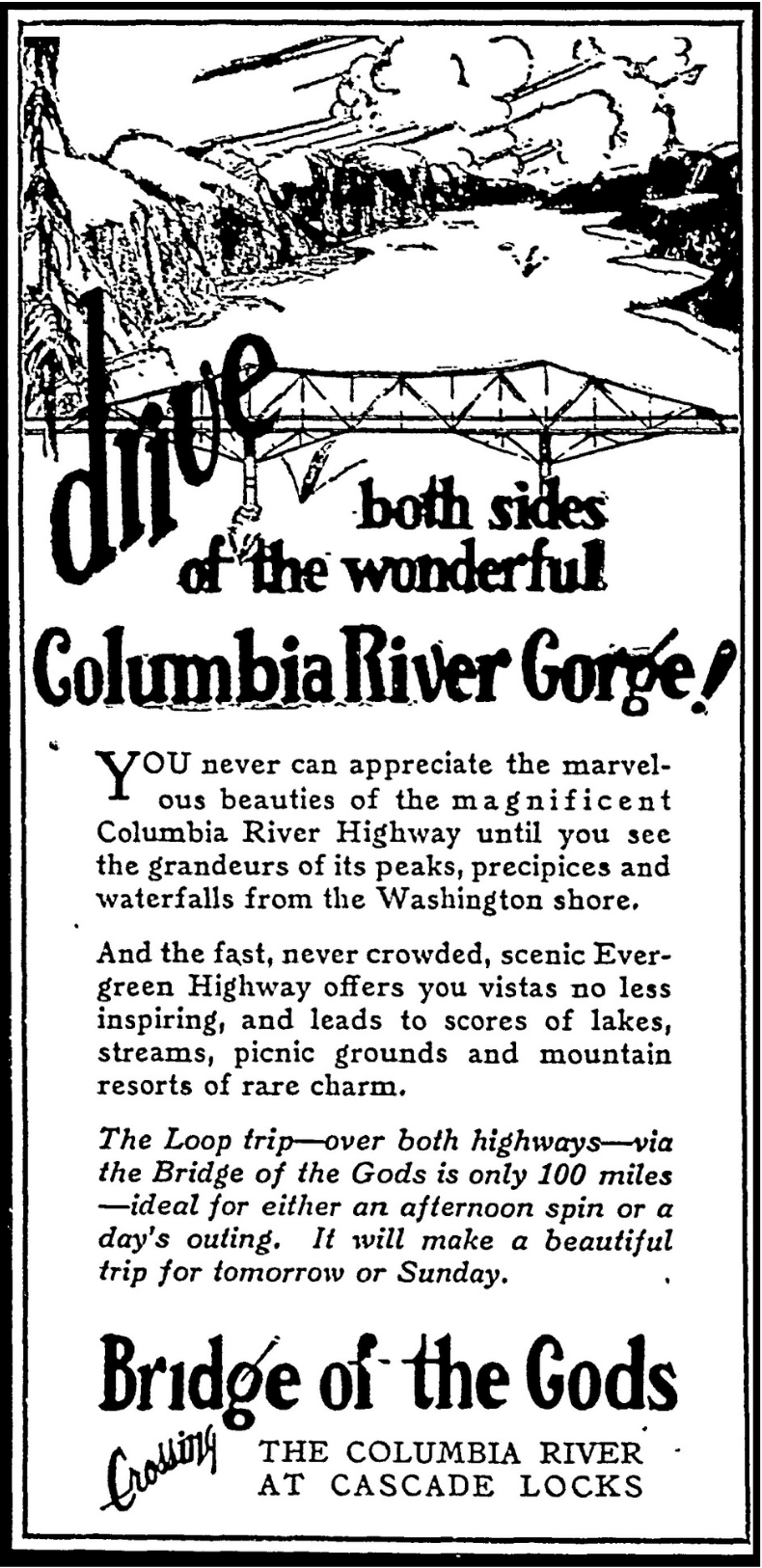
The architectural rendering of the planned suspension bridge was widely distributed to promote the vision of a bridge, generate excitement, and attract investors. Rendering by Fred Routledge.

With a rendering printed and demonstrated commitment to the project complete, the Bridge of the Gods Corporation printed marketing pamphlets and began an aggressive sales campaign. They engaged the Portland Ad Club to conduct a grandiose dedication ceremony.

On June 16, 1922, 3000 people came to the future site of the Bridge of the Gods. Portland Ad Club president George Rauch welcomed and introduced celebrity speakers throughout the event. George S. Allen, Governor Ben Olcott of Oregon, and Secretary of State J. Grant Hinkle of Washington gave short speeches celebrating the vision. Frederic Homer Balch’s sister, Gertrude Balch Ingalls, brought a bouquet of flowers from the Balch family farm in Hood River. She dedicated the flowers to her brother and to Chief Multnomah, who Balch had immortalized in his novel.

The headline speaker was Wasco-Klickitat elder Martin Spedis. Spedis gave the speech in his language with his son, Dave, as translator. The Spedis men were later joined by their wives, Ellen and Susie, and sister Lucy to perform a ceremony and dance.

Upon noticing him the audience, Rauch asked singer Walter Jenkins to lead some old-time songs. Portland Mayor George Baker closed the speeches.

To complete the dedication, the group gathered at the edge of the land. Dave Spedis shot an arrow from the completed pier across the river to symbolize the reconnection of the two landmasses and designate where the next pier should be built.
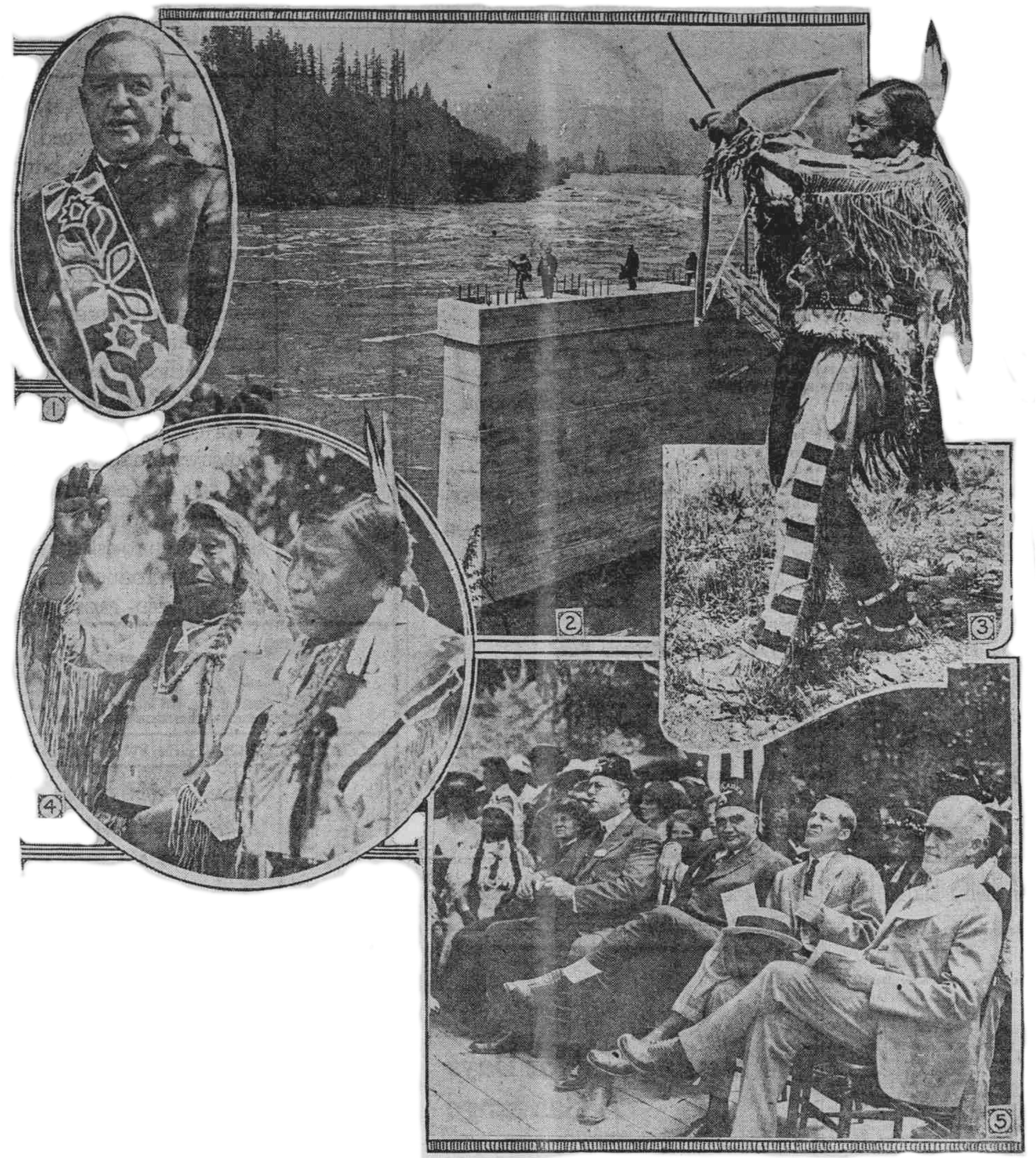
The Morning Oregonian ran this photo spread following the dedication ceremony on June 19, 1922. Photos include (1) George S. Allen, the originator of the Bridge of the Gods enterprise. (2) Completed pier on the Oregon shore of the river. (3) Dave Spedis shot the ceremonial arrow to symbolize the rejoining of the two sides of the river. (4) Martin Spedis gave a dedication speech with his son Dave as interpreter. (5) Speakers and presenters from left to right, Susie Silas Spedis, Gertrude Balch Ingalls, Portland Mayor George Baker, Oregon Governor Ben Olcott, Washington Secretary of State J. Grant Hinkle.
Constructing the Crossing

Wauna Toll Bridge Company contracted the construction work to Union Bridge Company out of Portland. Wauna Toll Bridge Company promised to pay the contractor half of all toll receipts between June and September in the year following completion to motivate them to complete the project quickly. They began preparing for work in November 1925 to take advantage of low water and make allowances for poor weather conditions.

Union Bridge Company collaborated with the Puget Sound Bridge and Dredging Company to update and complete the Bridge of the Gods. Union Bridge Company led the design and construction of the substructure, including the piers and supports. Puget Sound Bridge and Dredging Company’s chief engineer R.M. Murray updated the superstructure of the bridge design to a steel cantilever style in 1925. Murray also designed the Snake River Bridge and Twin-Falls Jerome Bridge.

Franklin W. Johnson came to Cascade Locks as local engineer for the Oregon side, and Lester S. Tubbs came to Stevenson as the local engineer for the Washington side. Johnson and Tubbs were recent alumni of the Oregon Agricultural College, now Oregon State University. They kept in contact with engineering faculty throughout the project and invited engineering students to inspect the bridge.

They brought in 50 men to complete the construction in January 1926. They worked in two crews, one on each side of the river to complete the lowest elevation work at the lowest water levels. A night crew was hired in February 1926 to get as much work done as possible before high water arrived in the spring.

In March 1926, the crew blasted the top 10 feet off of the first concrete pier with dynamite. The pier needed to be made larger to support the new steel cantilever design. The second concrete pier on the Oregon side was completed in April, and three piers on the Washington side soon followed. Stevenson company Hazard & Allen was contracted to complete the gravel and earth work for the Washington approach.

The Union Bridge Company allowed filmmakers to document the process of building the Bridge of the Gods.

Open for Traffic

As the Bridge of the Gods neared completion in the fall, estimates for the opening date depended on favorable weather. An opening ceremony planned Saturday, October 23, 1926 became a celebration of the joining of the spans.

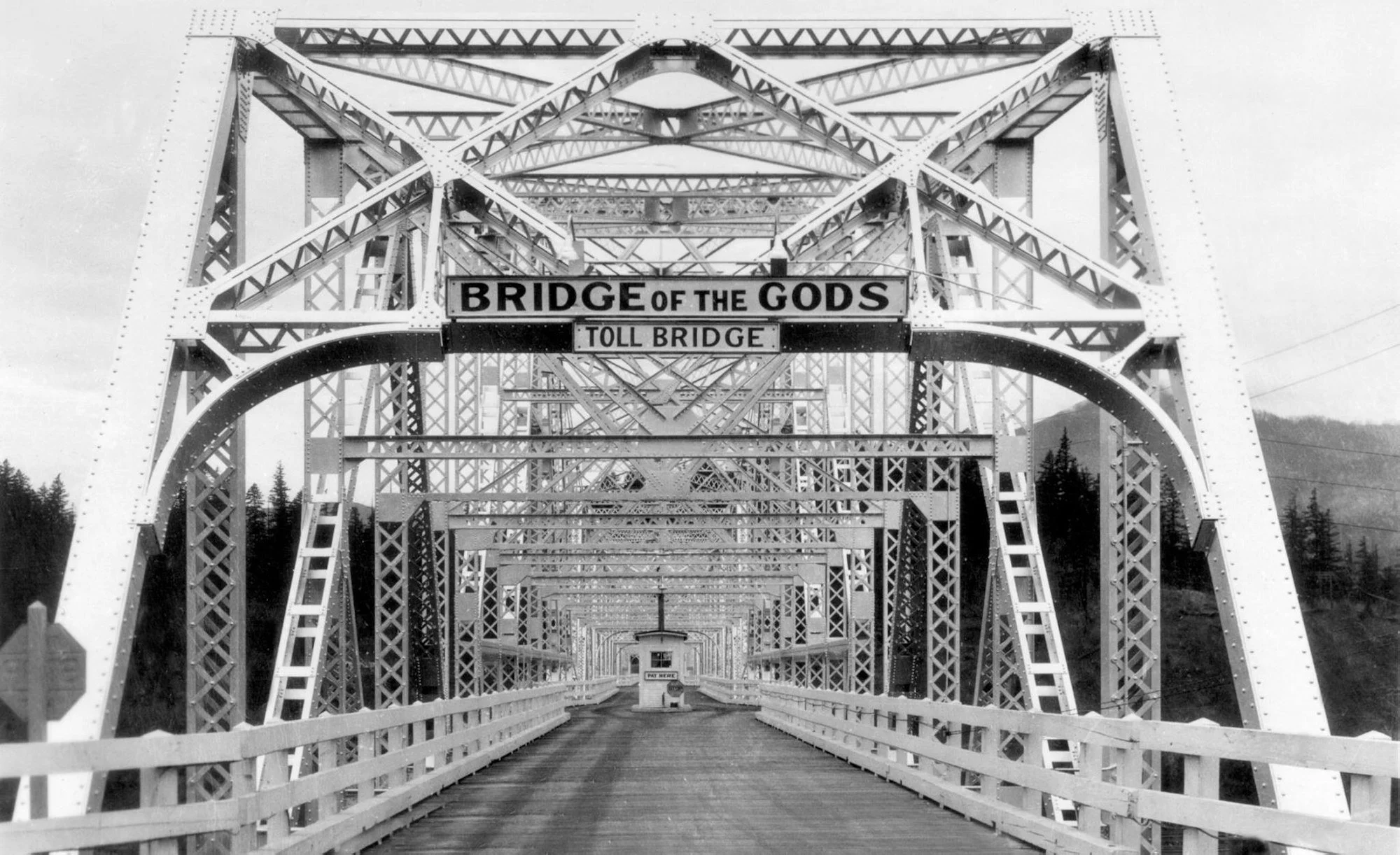
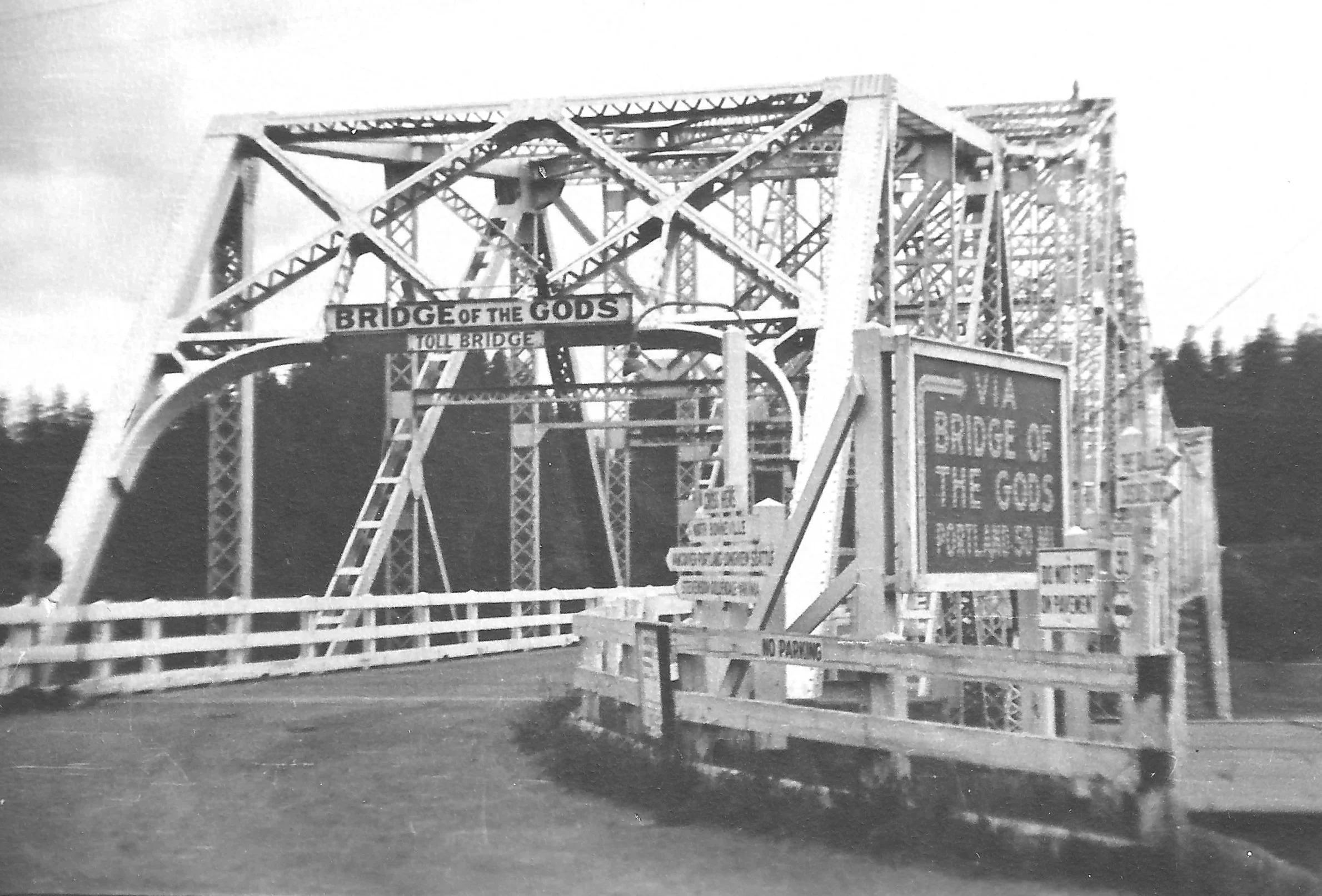
The completed Bridge of the Gods.

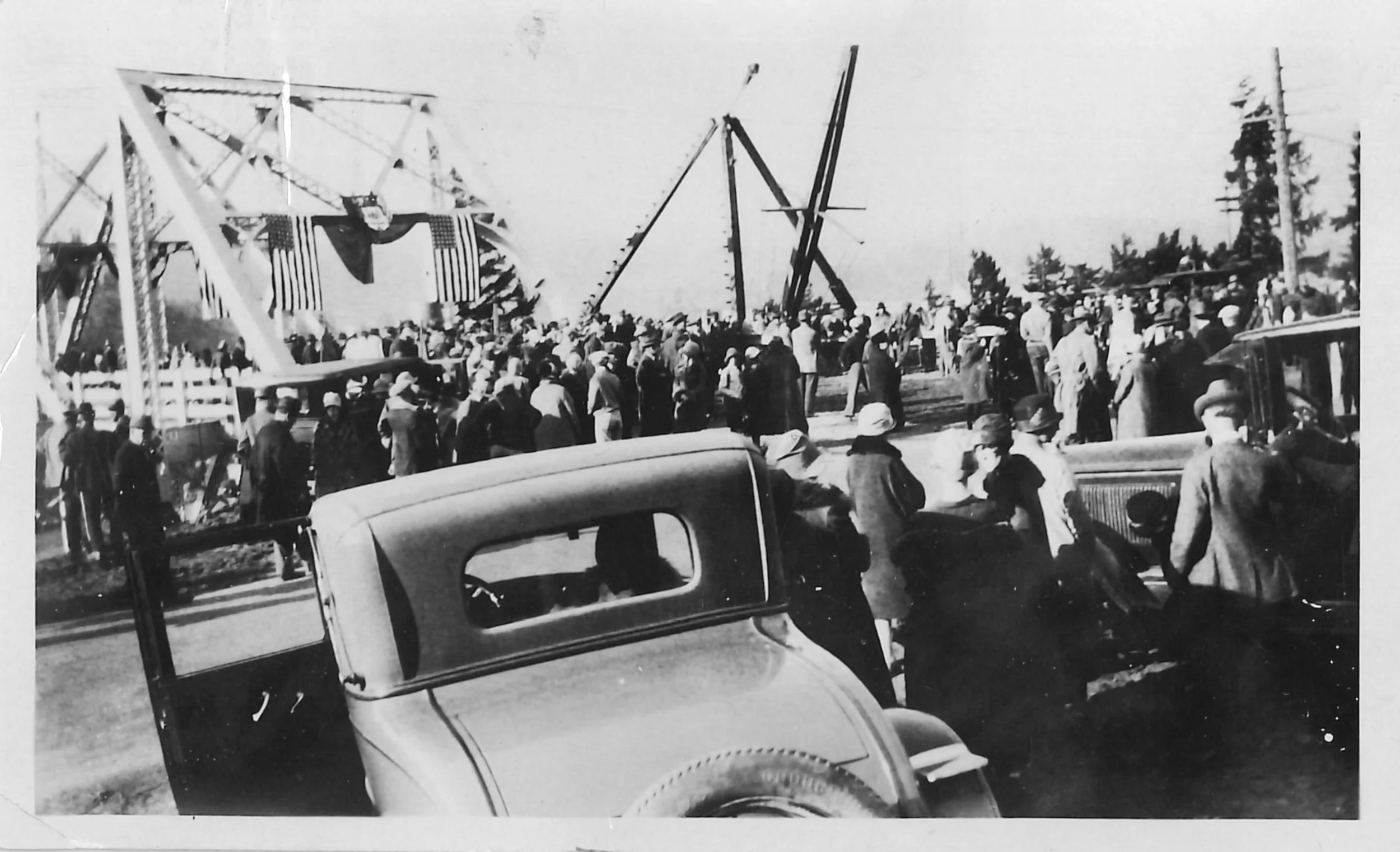
Finally, on Tuesday, October 26, 1926, workers and residents gathered for the official opening celebration. As the noon whistle blew, brother and sister Theodore Iman and Flora Iman Foster walked to the center of the bridge and shook hands. The siblings were selected for the ceremonial first meeting because Theodore was born in Cascade Locks and Flora in Stevenson before statehood. Following the handshake, everyone ran to the center line to meet and celebrate the Bridge opening.

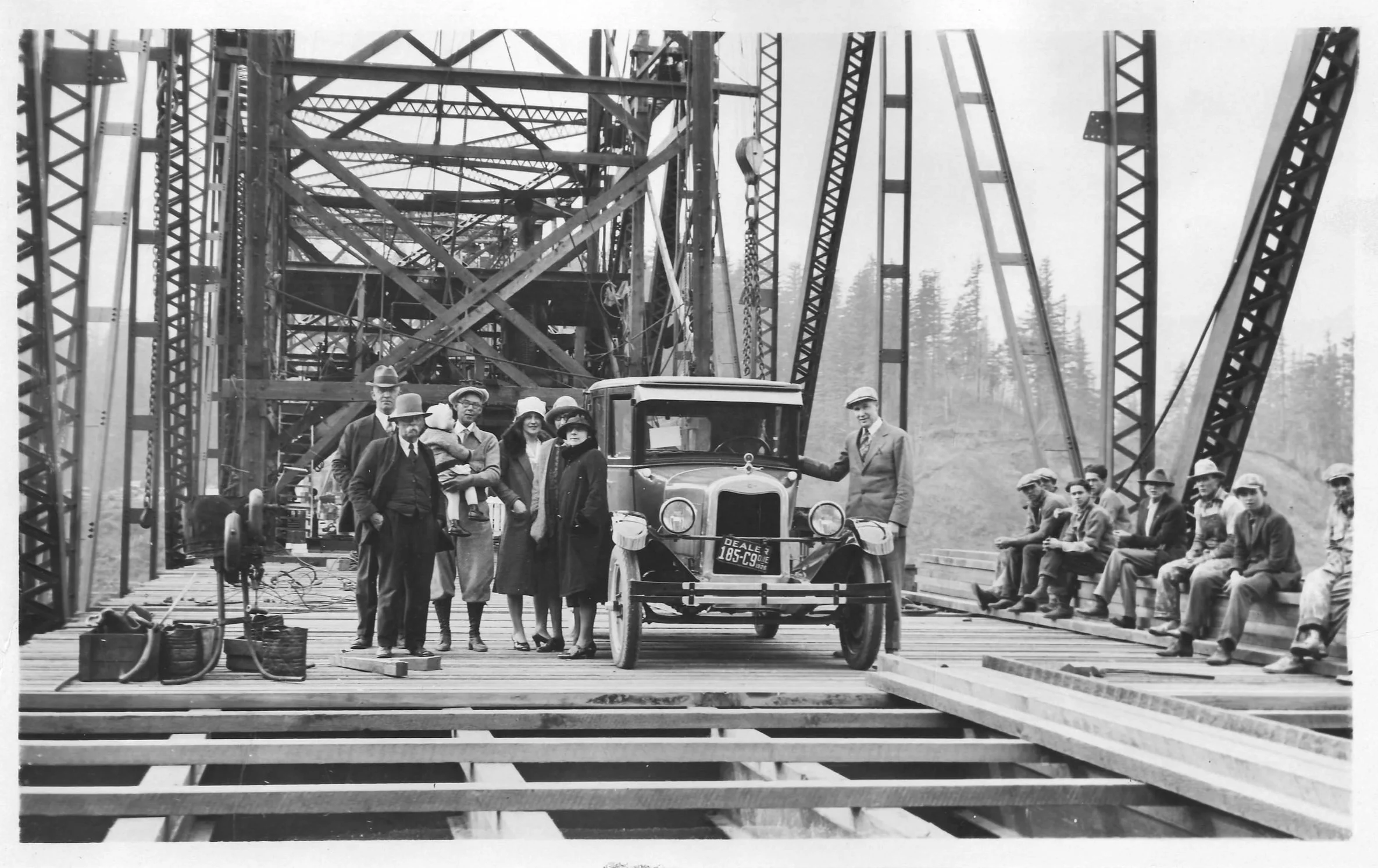
The first car held driver Walter Miller; Union Bridge Company superintendent B.A. McClain and secretary Jessie Findlay; chief engineer R.M. Murray and his family, and Oregonian journalist Frank Perkins and his family.

The first car to drive across the bridge was a Chevy sedan. While the steel work was finished, the wooden decking was not. They laid down planks to drive across.

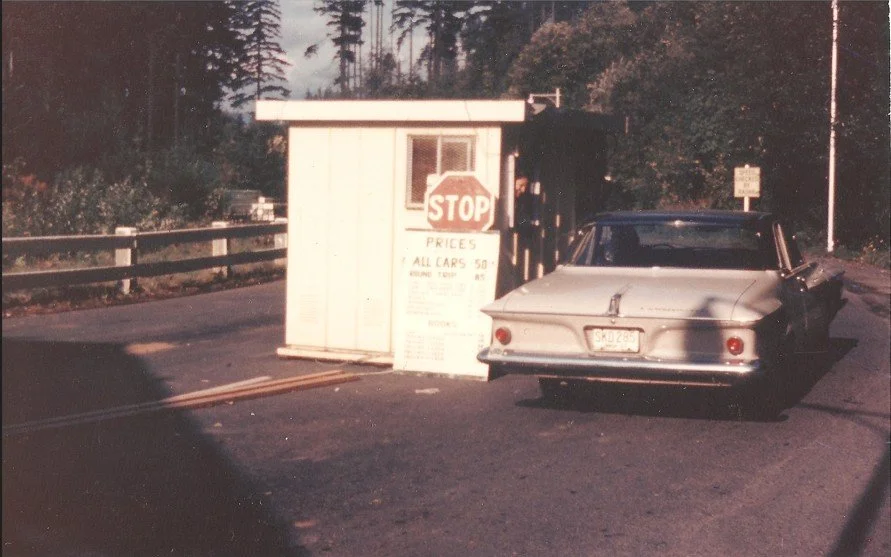
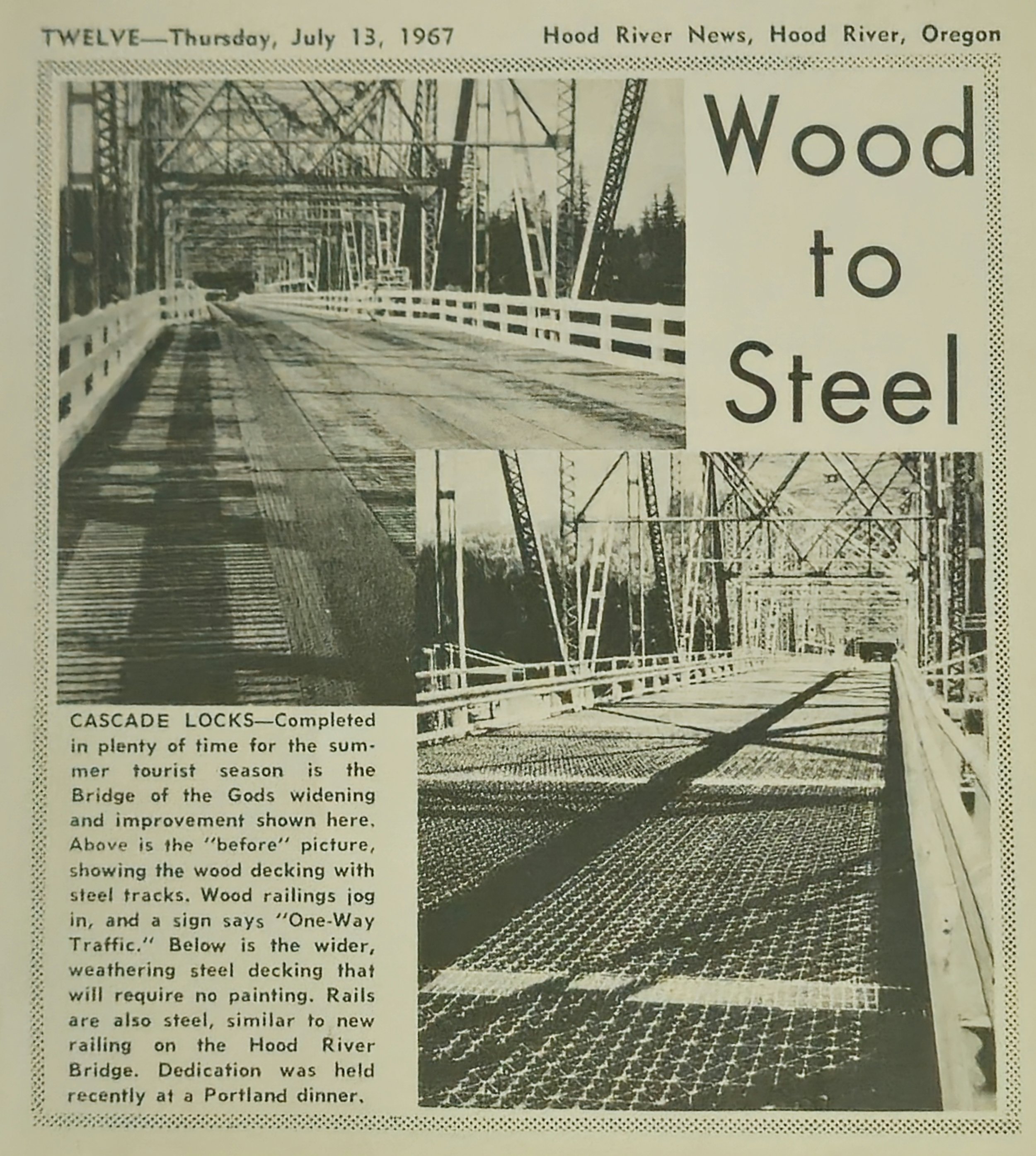
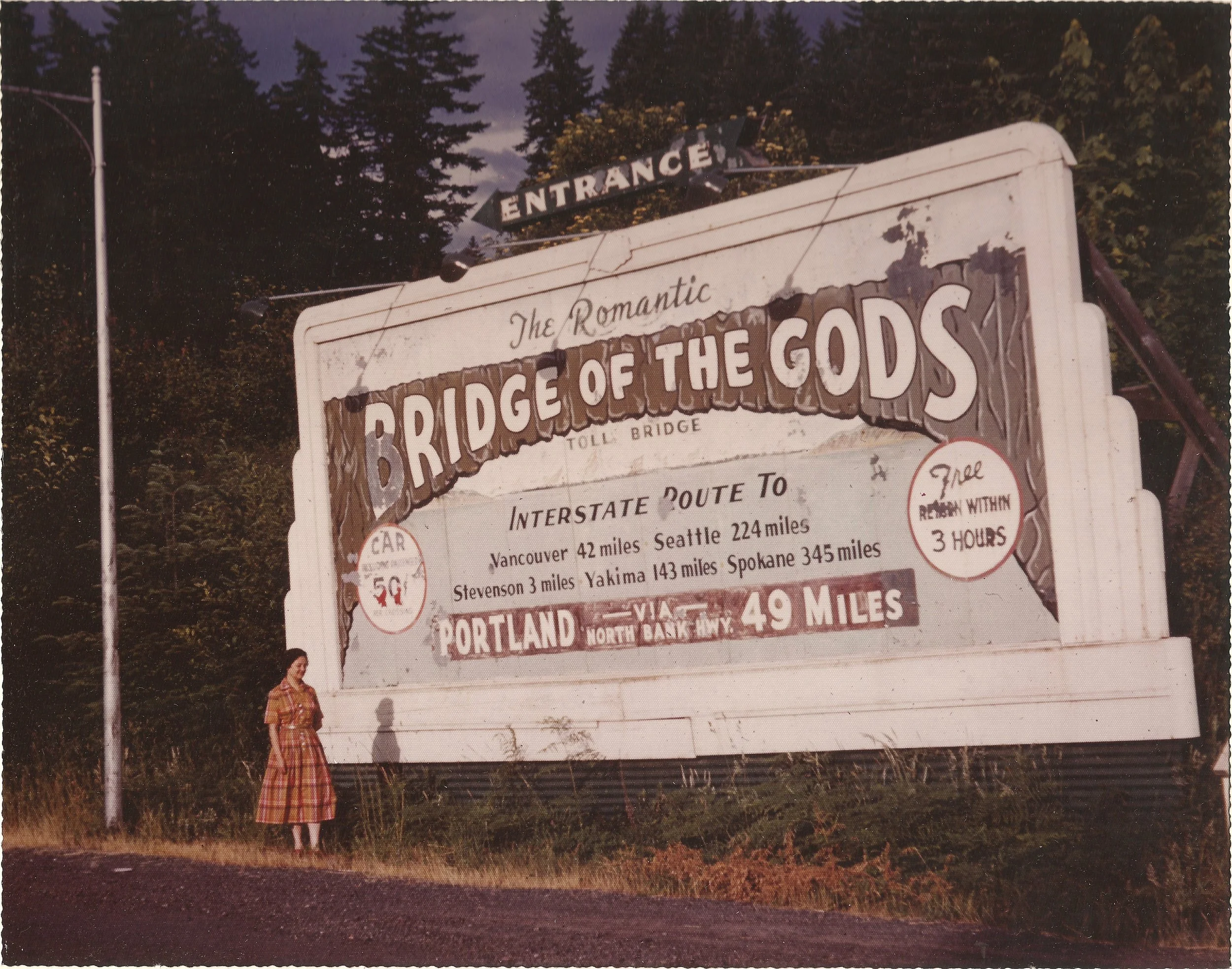
The Bridge of the Gods was originally decked in wood. It had whitewashed wooden guard rails that matched the style of the Columbia River Highway. The toll booth was placed in the middle of the span with turnouts for drivers to enjoy the view. Tolls were set at 50 cents, with a free return trip if drivers came back within three hours.

The Bridge of the Gods was an immediate success as an economic asset. Drivers were excited to experience the scenic loop without transit by ferry. Business went so well that management was able to make double bond payments within 10 years.

Lifting the Legend

When construction began on the Bonneville Dam in 1934, the federal government paid to move most of the infrastructure that would be flooded by the new water level, like the highway and the railroad. However, privately owned bridges were considered waterway obstructions. The $500,000 expense was determined to be the owners’ responsibility.

Excerpt from the 1937 US Army Corps of Engineers illustrated map showing the anticipated shoreline of the new reservoir.

The Wauna Toll Bridge Company recruited the owners of the Hood River bridge to jointly lobby for federal support. Negotiations included federal pressure to remove tolls, threats of punitive finesfor the waterway obstruction, and proposals to construct a toll-free bridge at Bonneville Dam. The federal government ultimately agreed to provide financial relief to the private owners in 1938.

The new reservoir behind Bonneville Dam raised the water level beneath the bridge that same year before any work was accomplished. The new clearance was only 90 feet above the river level.

The Bridge of the Gods closed on March 25, 1940 to complete the 44-foot lift. The Tavares Construction Company from California was awarded the contract for the bridge lift with a bid of $438,000. Engineer Carl Tavares came from Los Angeles to lead the project.

Workers inserted sheets of steel called shims between lifts. This was a failsafe to keep the span from slipping or dropping in case of an accident with the jacks.

Preparation work took place between March and May. The 300-foot center span was disassembled and stacked on near the roadway. The toll booth was relocated to the Oregon shore. Concrete counterweights were added to the spans to prevent tipping. Four 500-ton hydraulic jacks were installed beneath each main span bearing, with two 200-ton jacks placed on the anchor piers.

Finally, the spans were raised in seven-foot increments. The weekly work cycle was to raise one side of the span seven feet on Monday; construct concrete forms on Tuesday; place reinforcing steel on Wednesday; pour fast-hardening concrete on Thursday; then repeat on the opposite side. The Bridge of the Gods reopened on July 17, 1940, now 140 feet above the Columbia River.

Before 1938: A sternwheeler passing under the bridge during low water.

S.S. Charles L. Wheeler Jr. was the first deep sea freighter to pass through the lock at the Bonneville Dam, July 9, 1938. The fore and aft topmasts were removed to allow her to pass under the Bridge of the Gods and Hood River Bridge.

Local Control of the Toll

The Bridge of the Gods operated as expected for the next 19 years. The scenic loop was a success. Millions of travelers crossed the bridge. As more highways were built, shipping with trucks increased. The Bridge of the Gods connected an integral trade route, and millions of dollars in freight crossed the bridge. 

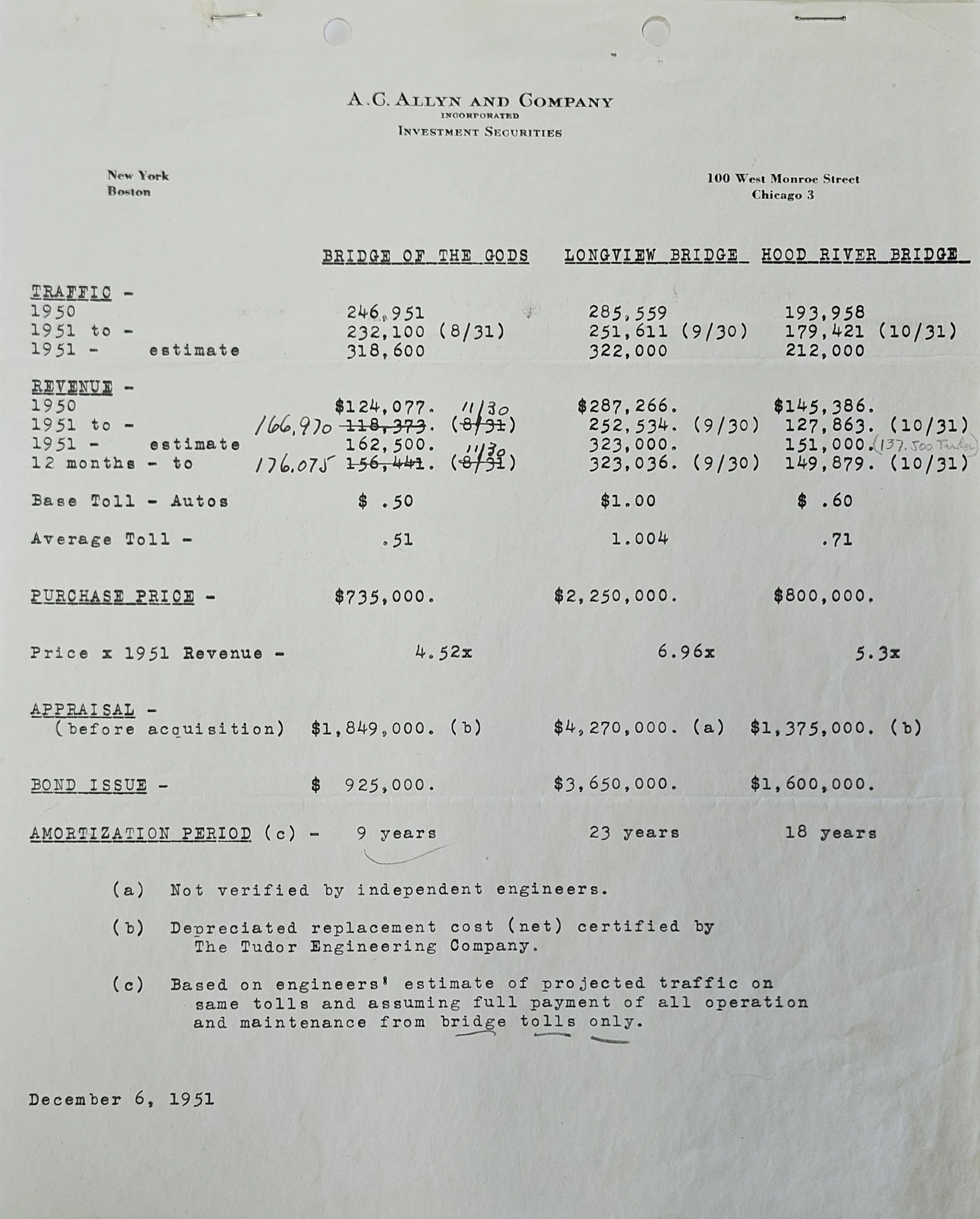
The parent company of the Walla Walla-based Wauna Toll Bridge Company began to shut down its operations in 1952. The Wauna Toll Bridge Company needed to pay back the $200,000 remaining on its mortgage. Shareholders decided to sell the Bridge of the Gods and cash out. They hired the same firms that handled the sale of the Hood River Bridge the previous year: bridge engineer Col. Ralph Tudor and Chicago-based investment firm A.C. Allyn & Co. The firms offered to sell the bridge to local governments for $735,000. 

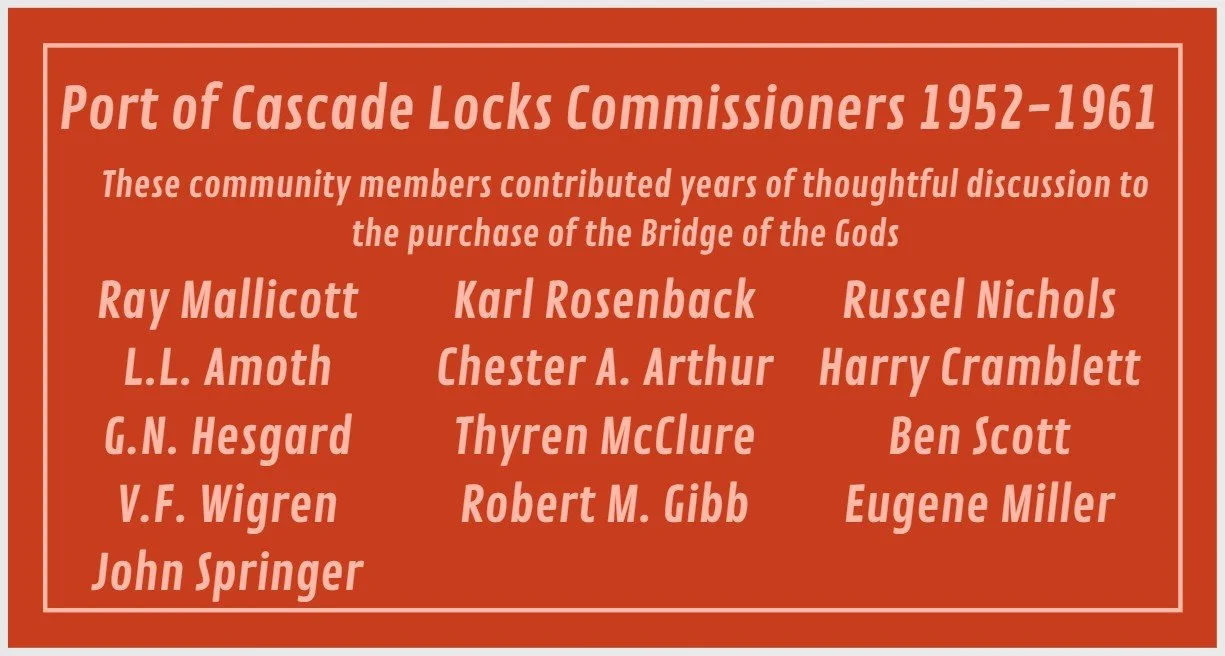
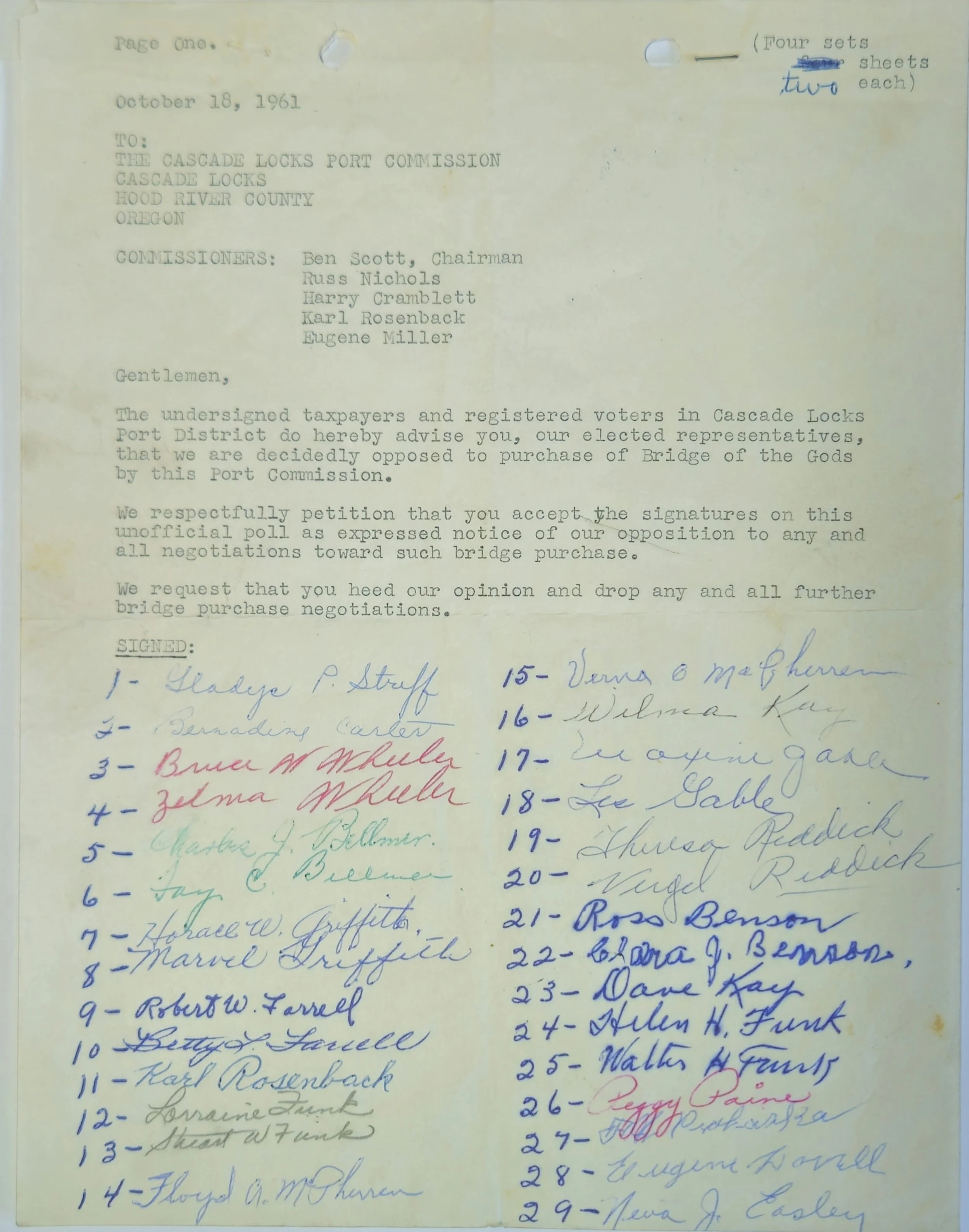
The Port of Cascade Locks saw an opportunity to keep toll revenue in the community rather than watching it go to outside investors. The port commission offered $735,000 for the bridge, and planned to borrow $925,000 in total bonds to cover additional repairs and improvements.    However, the emerging port had few assets to leverage. Opponents of the purchase attempted a recall election against three commissioners. Following a packed town hall meeting in May 1952, the port withdrew their offer, citing a lack of public support. 

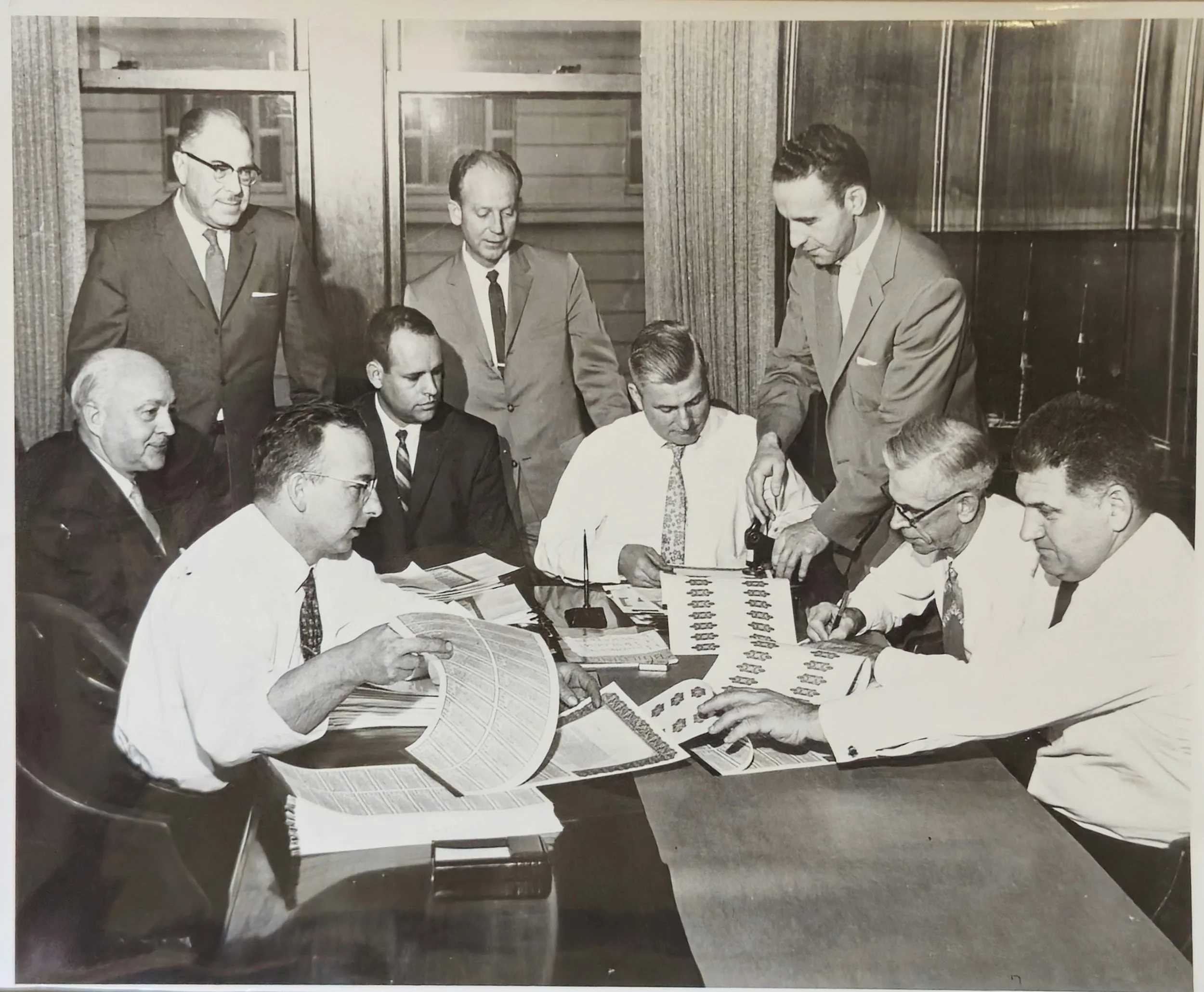
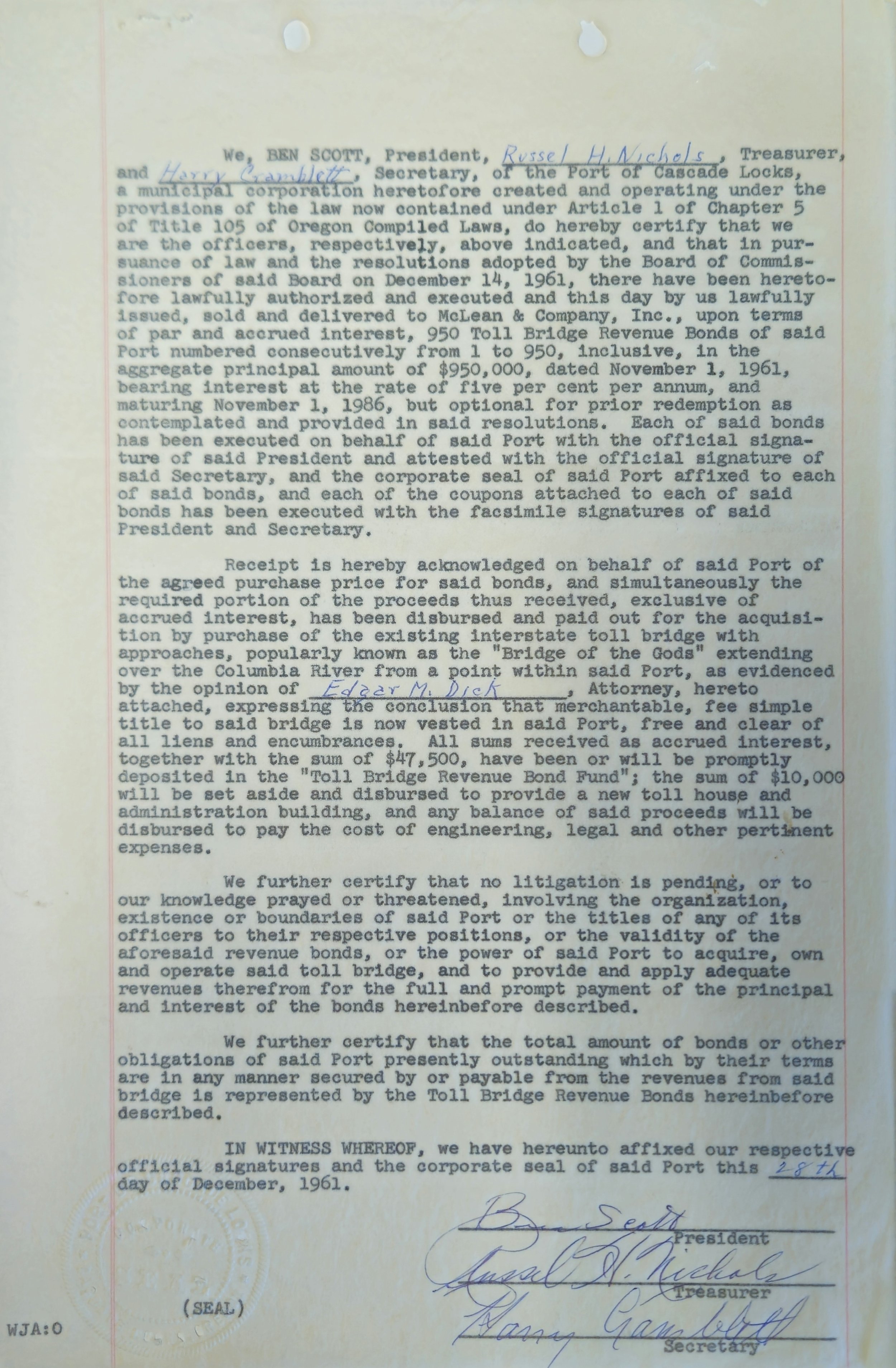
Instead, the Bridge of the Gods sold to A.C. Allyn & Co. for $735,000 in December 1952. The firm formed the Columbia River Toll Bridge Company, headquartered at their regional office in Spokane, to manage the bridge. They continued to negotiate with local municipalities interested in buying the bridge. After 9 years of discussion and growth, the Port bought the bridge for $892,500, backed by $950,000 in bonds, in December 1961.

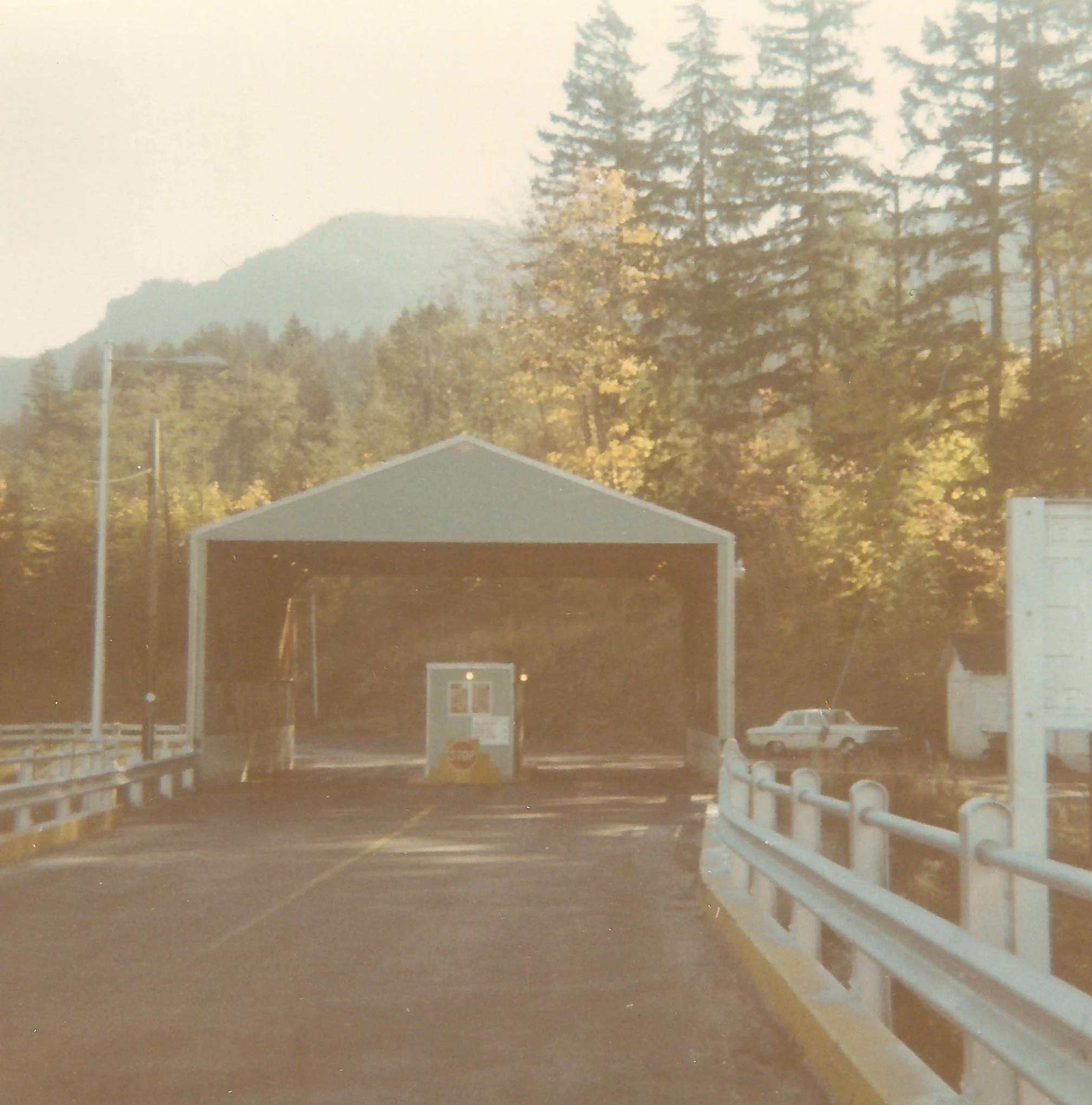
With the bridge finally under local control, the Port put toll revenue to work. The tollbooth was rebuilt in 1962. In 1967, the Port obtained $300,000 in additional bonds to fund the largest improvement yet: replacing the old wooden deck with a wider steel one. It was the kind of long-term investment prioritized by local users. The Port continues to maintain the bridge, reinvesting toll revenue in bridge upkeep and special projects in the community.