bridge engineer

Constructing the Crossing

Wauna Toll Bridge Company contracted the construction work to Union Bridge Company out of Portland. The company promised to pay the contractor half of all toll receipts between June and September in the year following completion to motivate them to complete the project quickly. They began preparing for work in November 1925 to take advantage of low water and make allowances for poor weather conditions.

Union Bridge Company chief engineer R.M. Murray updated the design to create the steel cantilevered bridge in 1925. Murray also designed the Snake River Bridge and Twin-Falls Jerome Bridge.

Franklin W. Johnson came to Cascade Locks as local engineer for the Oregon side, and Lester S. Tubbs came to Stevenson as the local engineer for the Washington side. Johnson and Tubbs were recent alumni of the Oregon Agricultural College, now Oregon State University. They kept in contact with engineering faculty throughout the project and invited engineering students to inspect the bridge.

Union Bridge Company subcontracted with the Puget Sound Bridge and Dredging Company. They brought in 50 men to complete the construction in January 1926. They worked in two crews, one on each side of the river to complete the lowest elevation work at the lowest water levels. A night crew was hired in February 1926 to get as much work done as possible before high water arrived in the spring.

In March 1926, the crew blasted the top 10 feet off of the first concrete pier with dynamite. The pier needed to be made larger to support the new steel cantilever design. The second concrete pier on the Oregon side was completed in April, and three piers on the Washington side soon followed. Stevenson company Hazard & Allen was contracted to complete the gravel and earth work for the Washington approach.

The Union Bridge Company allowed filmmakers to document the process of building the Bridge of the Gods.
Open for Traffic

As the Bridge of the Gods neared completion in the fall, estimates for the opening date depended on favorable weather. An opening ceremony planned Saturday, October 23, 1926 became a celebration of the joining of the spans.

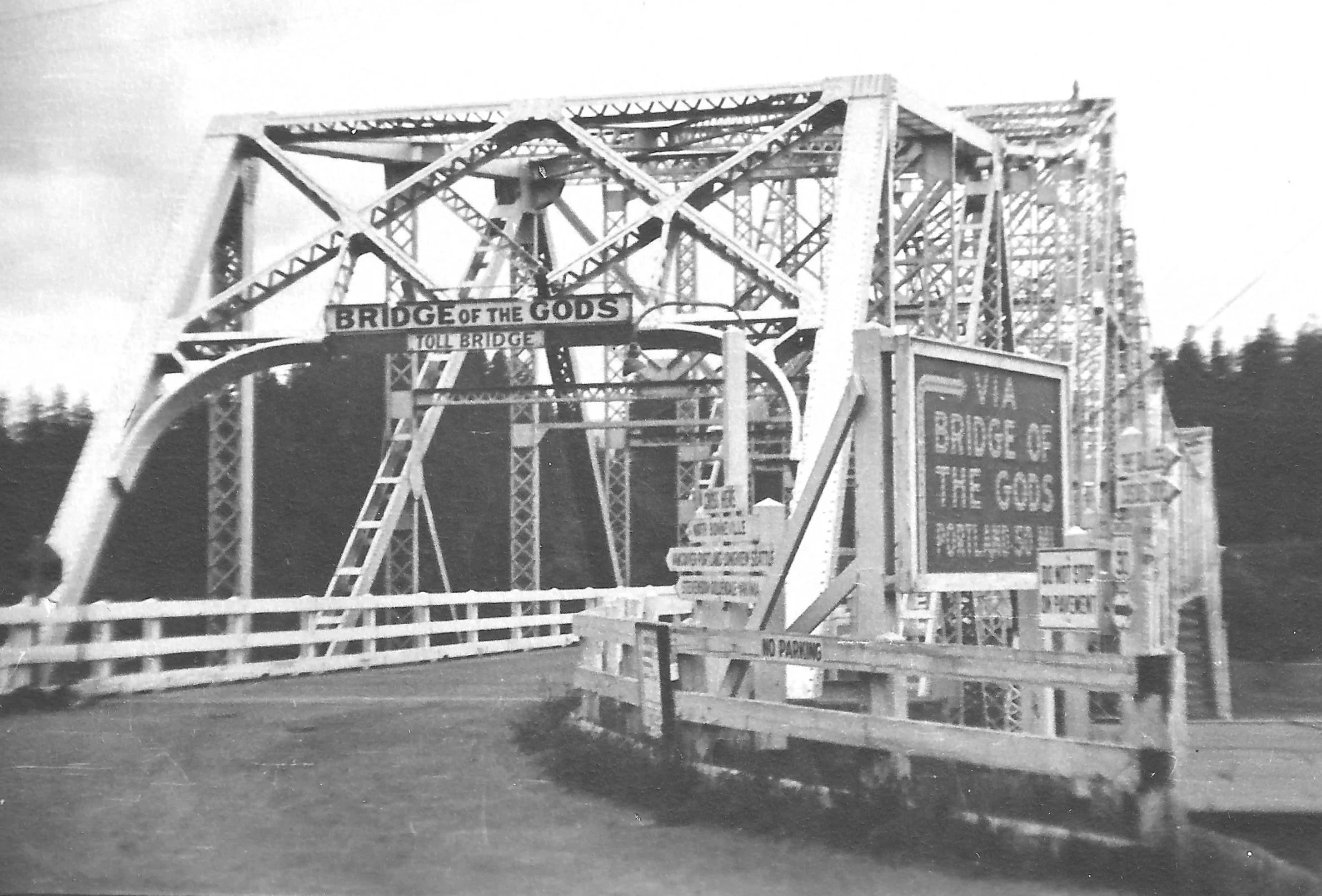
The completed Bridge of the Gods.

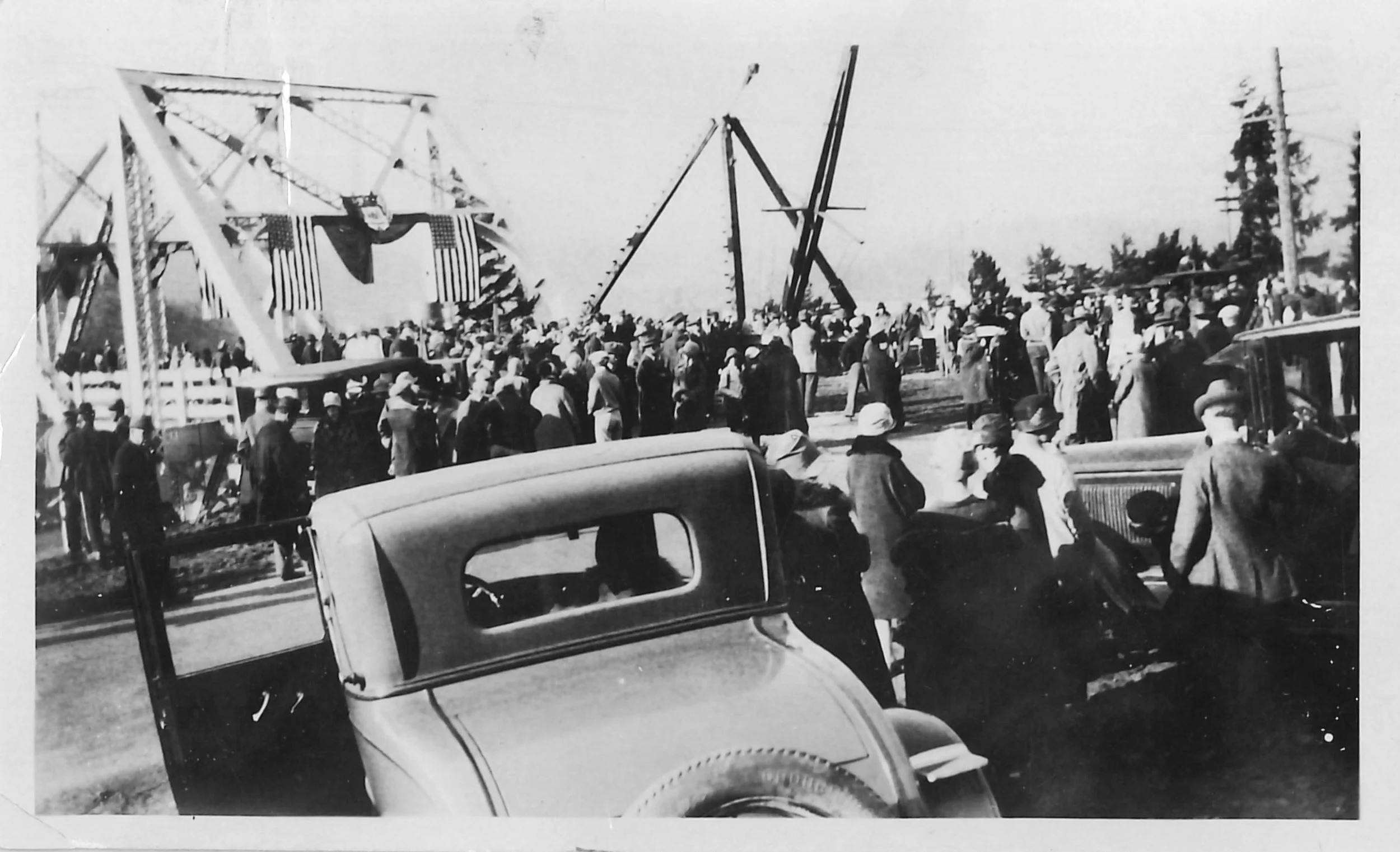
Finally, on Tuesday, October 26, 1926, workers and residents gathered for the official opening celebration. As the noon whistle blew, brother and sister Theodore Iman and Flora Iman Foster walked to the center of the bridge and shook hands. The siblings were selected for the ceremonial first meeting because Theodore was born in Cascade Locks and Flora in Stevenson before statehood. Following the handshake, everyone ran to the center line to meet and celebrate the Bridge opening.

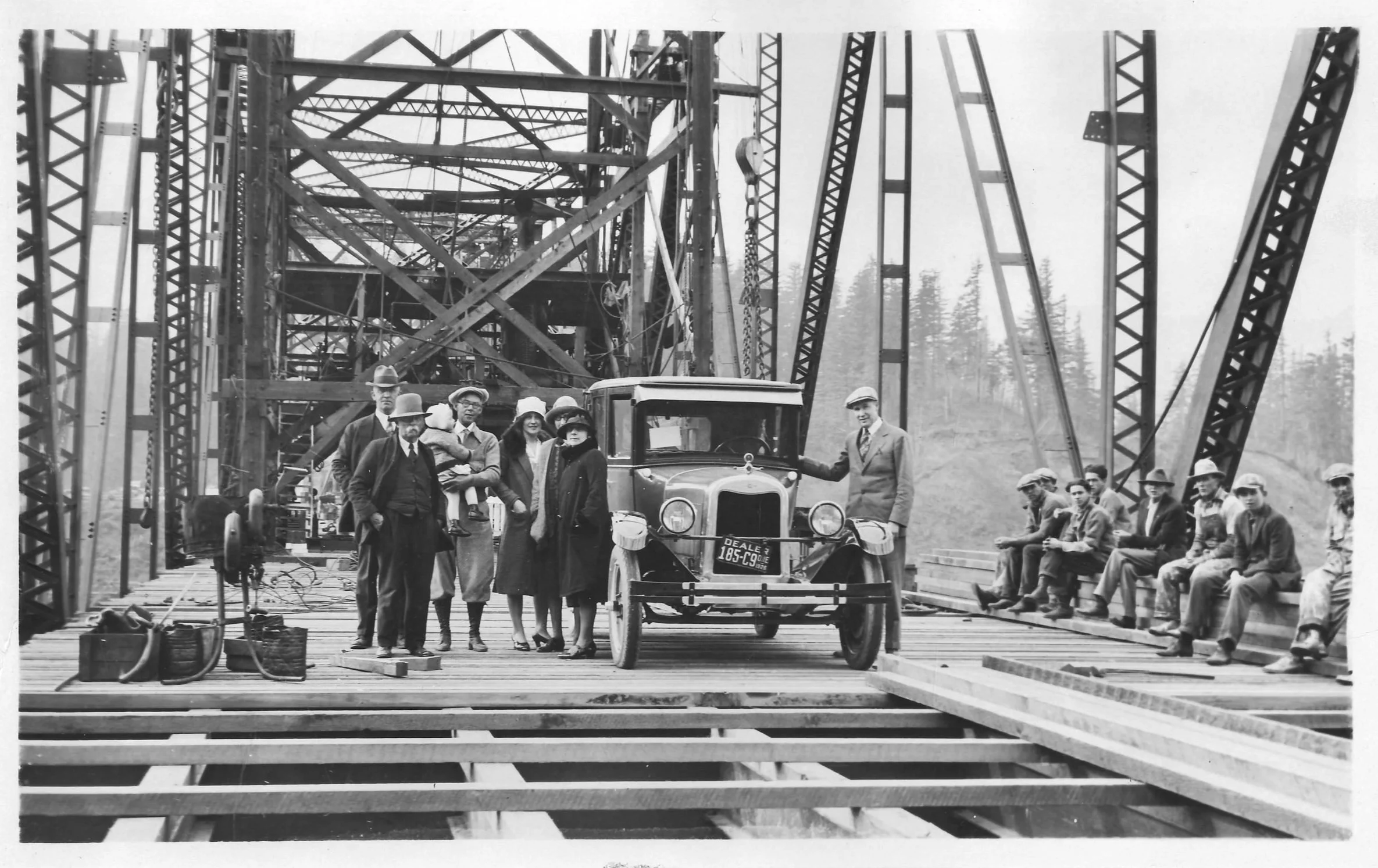
The first car held driver Walter Miller; Union Bridge Company superintendent B.A. McClain and secretary Jessie Findlay; chief engineer R.M. Murray and his family, and Oregonian journalist Frank Perkins and his family.

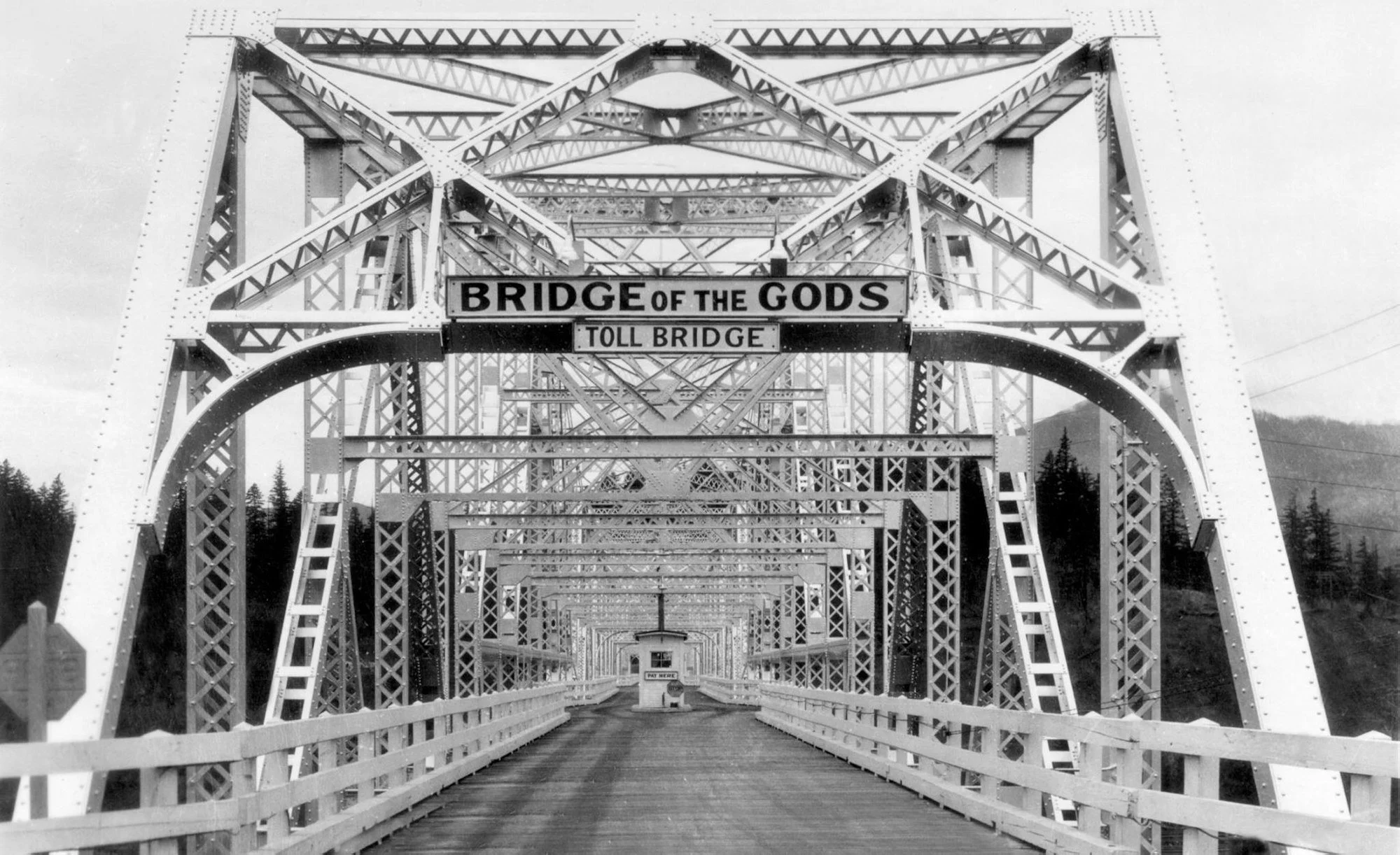
The first car to drive across the bridge was a Chevy sedan. While the steel work was finished, the wooden decking was not. They laid down planks to drive across.

The Bridge of the Gods was originally decked in wood. It had whitewashed wooden guard rails that matched the style of the Columbia River Highway. The toll booth was placed in the middle of the span with turnouts for drivers to enjoy the view. Tolls were set at 50 cents, with a free return trip if drivers came back within three hours.

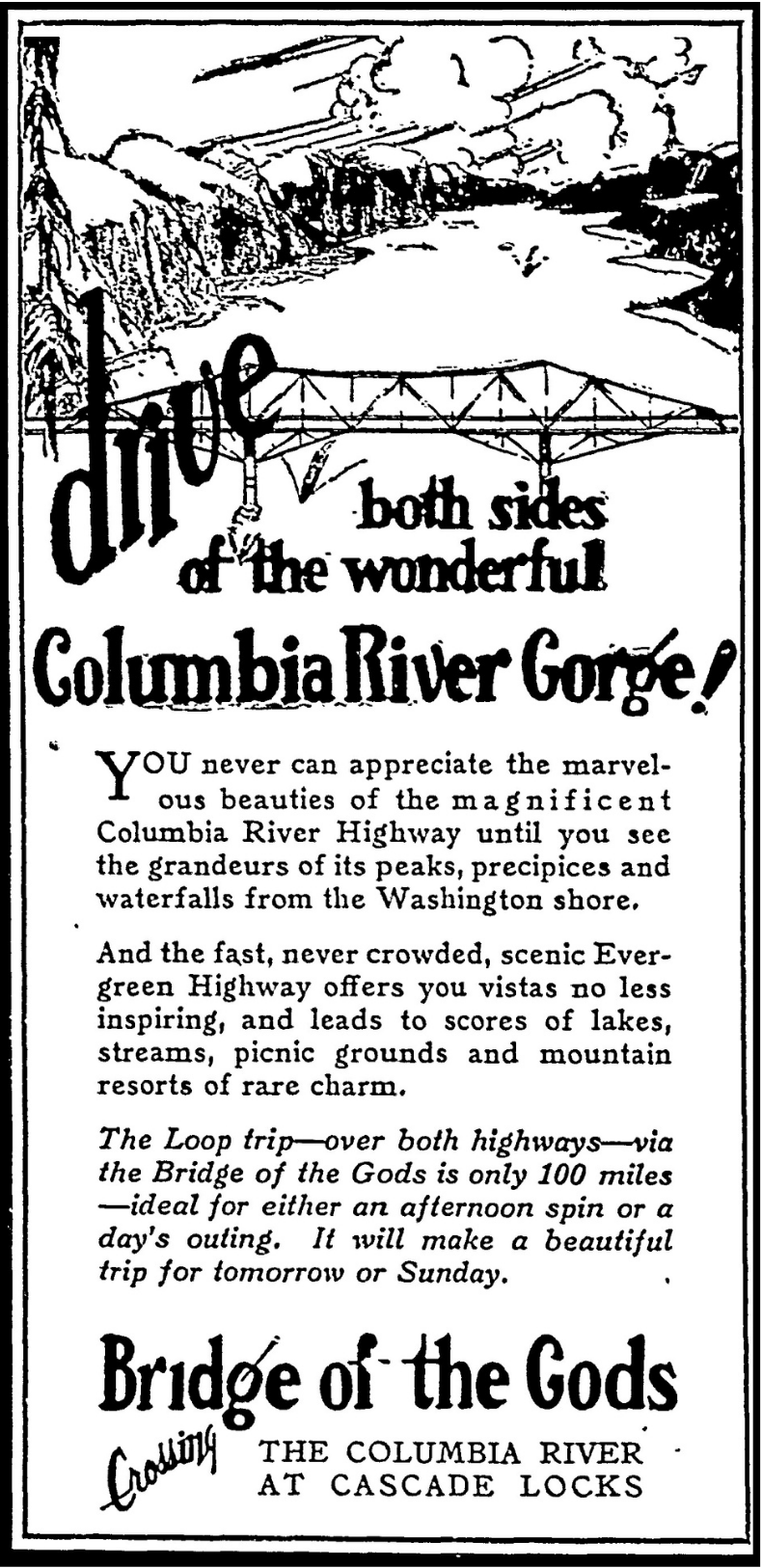
The Bridge of the Gods was an immediate success as an economic asset. Drivers were excited to experience the scenic loop without transit by ferry. Business went so well that management was able to make double bond payments within 10 years.

Lifting the Legend

When construction began on the Bonneville Dam in 1934, the federal government paid to move most of the infrastructure that would be flooded by the new water level, like the highway and the railroad. However, privately owned bridges were considered waterway obstructions. The $500,000 expense was determined to be the owners’ responsibility.

Excerpt from the 1937 US Army Corps of Engineers illustrated map showing the anticipated shoreline of the new reservoir.

The Wauna Toll Bridge Company recruited the owners of the Hood River bridge to jointly lobby for federal support. Negotiations included federal pressure to remove tolls, threats of punitive finesfor the waterway obstruction, and proposals to construct a toll-free bridge at Bonneville Dam. The federal government ultimately agreed to provide financial relief to the private owners in 1938.

The new reservoir behind Bonneville Dam raised the water level beneath the bridge that same year before any work was accomplished. The new clearance was only 90 feet above the river level.

The Bridge of the Gods closed on March 25, 1940 to complete the 44-foot lift. The Tavares Construction Company from California was awarded the contract for the bridge lift with a bid of $438,000. Engineer Carl Tavares came from Los Angeles to lead the project.

Workers inserted sheets of steel called shims between lifts. This was a failsafe to keep the span from slipping or dropping in case of an accident with the jacks.

Preparation work took place between March and May. The 300-foot center span was disassembled and stacked on near the roadway. The toll booth was relocated to the Oregon shore. Concrete counterweights were added to the spans to prevent tipping. Four 500-ton hydraulic jacks were installed beneath each main span bearing, with two 200-ton jacks placed on the anchor piers.

Finally, the spans were raised in seven-foot increments. The weekly work cycle was to raise one side of the span seven feet on Monday; construct concrete forms on Tuesday; place reinforcing steel on Wednesday; pour fast-hardening concrete on Thursday; then repeat on the opposite side. The Bridge of the Gods reopened on July 17, 1940, now 140 feet above the Columbia River.

Before 1938: A sternwheeler passing under the bridge during low water.

Between 1938-1940: S.S. Charles L. Wheeler Jr. was the first deep sea freighter to pass through the lock at the Bonneville Dam, July 9, 1938. The fore and aft topmasts were removed to allow her to pass under the Bridge of the Gods and Hood River Bridge.