
The Bridge of the Gods Corporation was approved to sell $300,000 worth of stock in Washington in 1921 and $250,000 of stock in Oregon in 1923. Stock sold for $1 per share. R.R. Clark was hired to design and engineer the bridge. L.A. Thomas served as a consulting architect. They favored a suspension bridge, stating that this design would best sustain strong Gorge winds. The Young McDonald Company built the first pier in April of 1922.
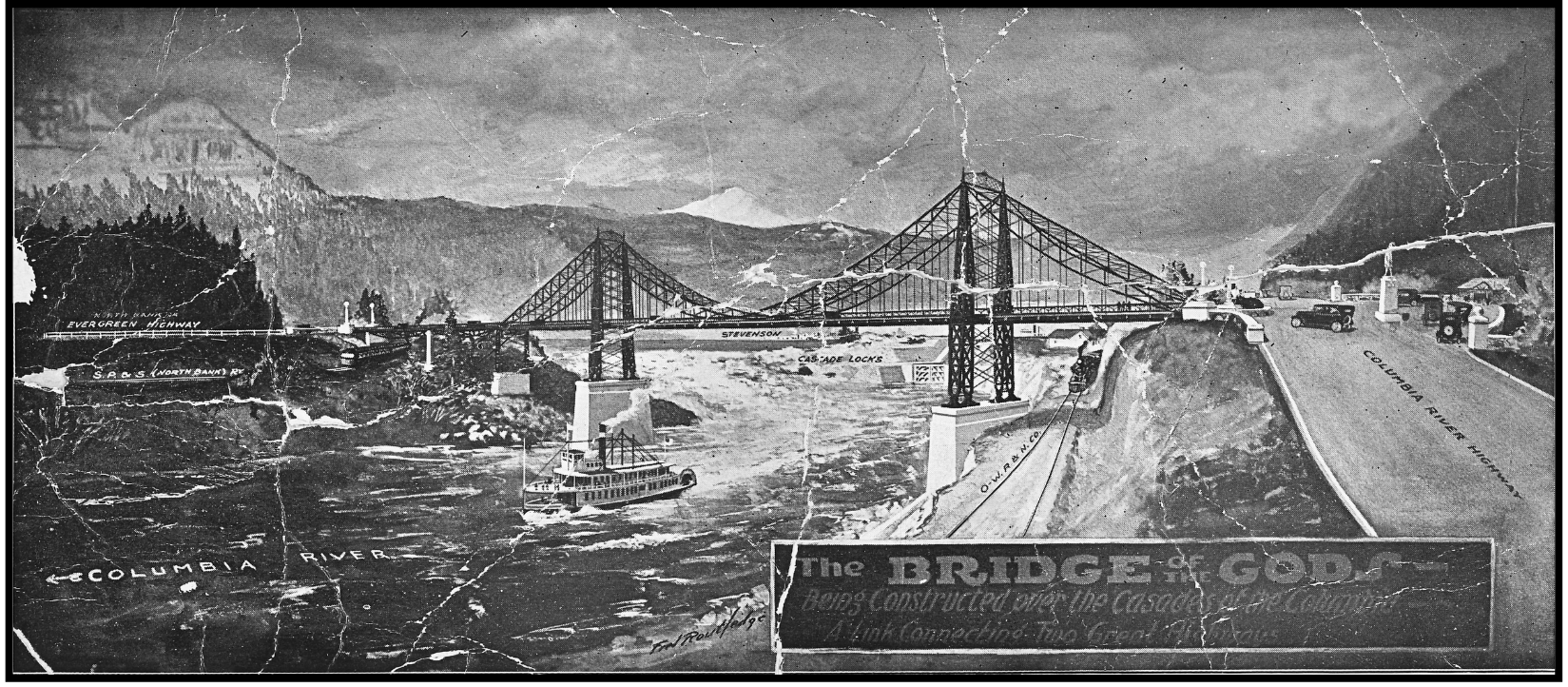
The architectural rendering of the planned suspension bridge was widely distributed to promote the vision of a bridge, generate excitement, and attract investors. Rendering by Fred Routledge.
With a rendering printed and demonstrated commitment to the project complete, the Bridge of the Gods Corporation printed marketing pamphlets and began an aggressive sales campaign. They engaged the Portland Ad Club to conduct a grandiose dedication ceremony.
On June 16, 1922, 3000 people came to the future site of the Bridge of the Gods. Portland Ad Club president George Rauch welcomed and introduced celebrity speakers throughout the event. George S. Allen, Governor Ben Olcott of Oregon, and Secretary of State J. Grant Hinkle of Washington gave short speeches celebrating the vision. Frederic Homer Balch’s sister, Gertrude Balch Ingalls, brought a bouquet of flowers from the Balch family farm in Hood River. She dedicated the flowers to her brother and to Chief Multnomah, who Balch had immortalized in his novel.
The headline speaker was Wasco-Klickitat elder Martin Spedis. Spedis gave the speech in his language with his son, Dave, as translator. The Spedis men were later joined by their wives, Ellen and Susie, and sister Lucy to perform a ceremony and dance.
Upon noticing him the audience, Rauch asked singer Walter Jenkins to lead some old-time songs. Portland Mayor George Baker closed the speeches.
To complete the dedication, the group gathered at the edge of the land. Dave Spedis shot an arrow from the completed pier across the river to symbolize the reconnection of the two landmasses and designate where the next pier should be built.
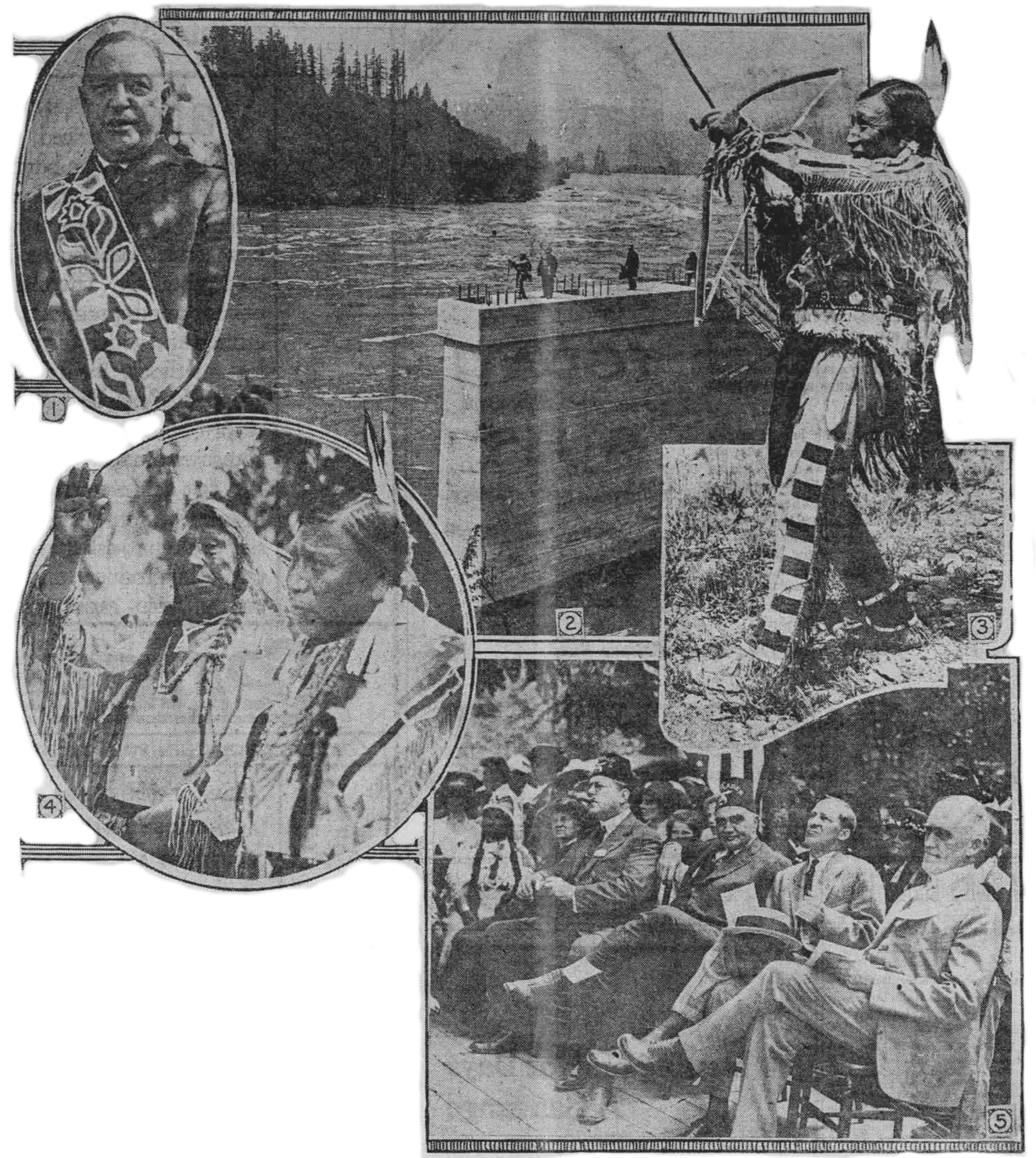
The Morning Oregonian ran this photo spread following the dedication ceremony on June 19, 1922. Photos include (1) George S. Allen, the originator of the Bridge of the Gods enterprise. (2) Completed pier on the Oregon shore of the river. (3) Dave Spedis shot the ceremonial arrow to symbolize the rejoining of the two sides of the river. (4) Martin Spedis gave a dedication speech with his son Dave as interpreter. (5) Speakers and presenters from left to right, Susie Silas Spedis, Gertrude Balch Ingalls, Portland Mayor George Baker, Oregon Governor Ben Olcott, Washington Secretary of State J. Grant Hinkle.